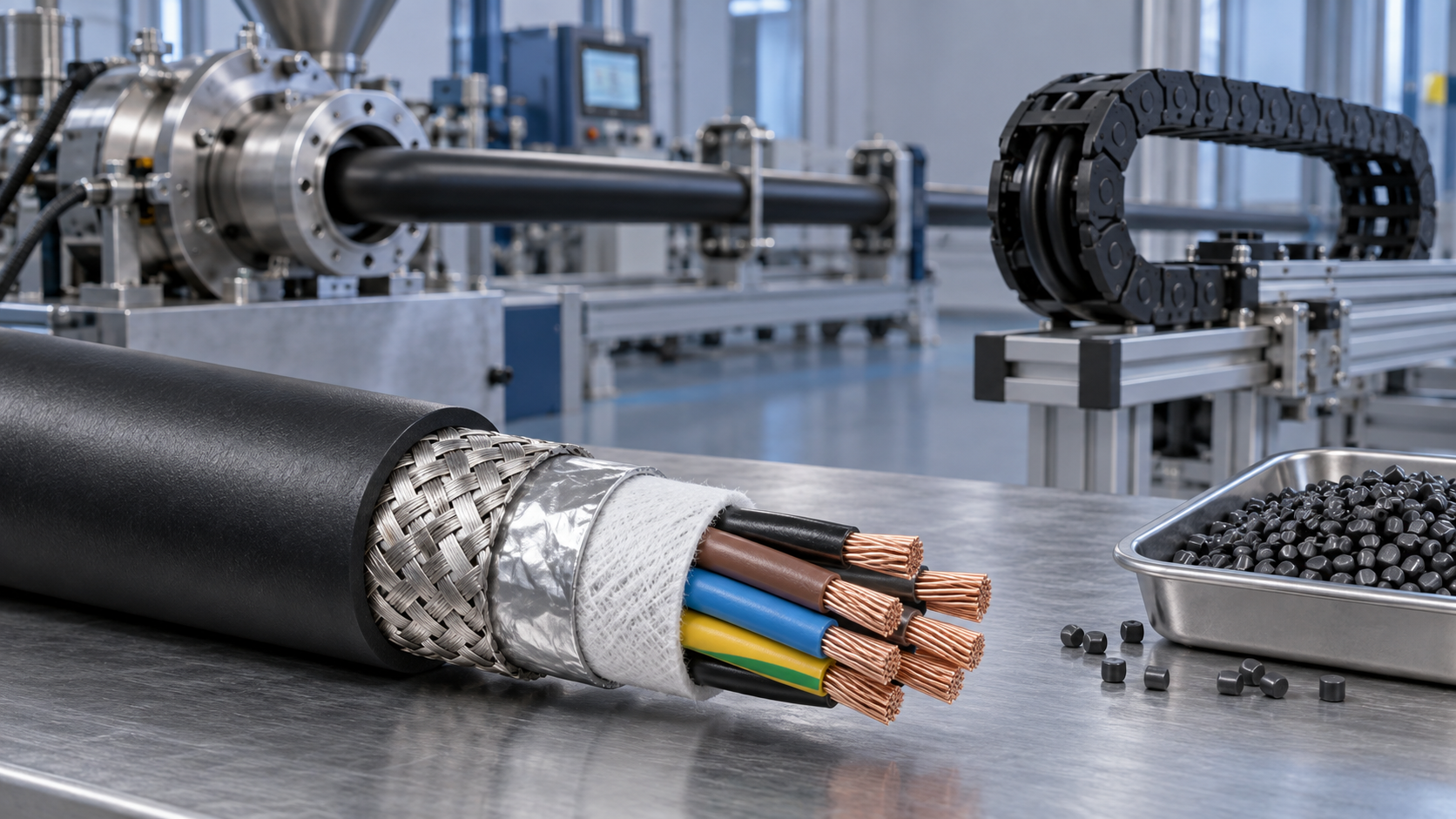
PUR is widely used on high-flex industrial cables because it combines a tough surface with useful flexibility. The jacket material matters, but the construction underneath matters just as much.
If you've ever spec'ed a drag chain cable, a robot cable, or a CNC machine tool cable, you've probably noticed that the most durable, most expensive options all share one thing: a PUR jacket.
PUR—short for polyurethane—is widely regarded as the toughest jacket material available for cables in continuous motion. But what exactly makes it special? How does it compare to PVC and TPE? And is it always the right choice?
This guide covers everything you need to know about PUR cable jackets: the material behind the name, its real-world properties, a head-to-head comparison with PVC and TPE, and a practical checklist for choosing the right PUR cable for your application.
PUR is the abbreviation commonly used for polyurethane. In cable manufacturing, the jacket is generally made from thermoplastic polyurethane, or TPU. It can be heated, extruded around the cable core and cooled into a durable outer sheath.
TPU belongs to the wider thermoplastic elastomer family. That means “TPE” is a broad material category, while TPU is one particular type within it. A catalogue that says only “TPE jacket” does not tell you whether the material is polyurethane, polyolefin-based or another formulation.
There is another important point: PUR is a family of compounds, not one fixed recipe. Base chemistry, hardness, additives and processing can change resistance to oil, water, ultraviolet light, flame and low temperature. Two black PUR cables may look almost identical while performing differently in service.
The useful question is therefore not only, “Is the jacket PUR?” It is, “Which PUR compound and complete cable construction suit my application?”
In a fixed installation, a cable may remain untouched for years. Inside a drag chain or on moving machinery, it bends repeatedly, contacts carrier surfaces and may be exposed to cutting fluids, lubricants, chips and temperature changes.
The jacket is the first layer facing that environment. It helps determine:
Once the jacket wears through, moisture and contaminants can reach the cable core. A shield may be damaged, cores can shift and conductor stress increases. Jacket selection is therefore a reliability decision, not just a choice of colour or appearance.
Abrasion resistance is the property most closely associated with PUR. A suitable compound can withstand repeated rubbing better than many general-purpose jacket materials. This is useful in cable carriers, machine tools, automated handling equipment and other installations where cable surfaces contact guides or neighbouring cables.
PUR is not a cure for poor routing. Overfilling a carrier, allowing cables to cross or operating below the specified bend radius can still damage the jacket.
A good PUR jacket resists cutting and helps prevent a small nick from turning quickly into a long tear. This is valuable around metal edges, chips and equipment that receives frequent maintenance.
It does not make the cable armoured or crush-proof. Where impact, sharp swarf or heavy mechanical loading is expected, routing and additional protection remain necessary.
PUR is often selected for equipment exposed to mineral oils, grease, machining coolant and hydraulic fluid. This is one reason it is common on CNC machines and factory-automation systems.
The exact fluid still matters. Chemical type, concentration, temperature, exposure time and splash versus continuous immersion can change the result. “Oil resistant” should not be read as “resistant to every industrial chemical.” Give the cable supplier the product name or safety data sheet of the fluid whenever possible.
Many PUR formulations remain flexible at temperatures where some conventional PVC jackets become stiff. This can help in cold workshops, outdoor machinery and refrigerated equipment.
There is no single temperature range for every PUR cable. Fixed and moving ratings may also differ. Always use the temperature stated for the complete cable, not a general value for the polymer.
Polyether-based TPU grades are often chosen when humidity, hydrolysis, microbial exposure and low-temperature flexibility are priorities. Polyester-based TPU grades are often considered where oil, grease and mechanical performance are the main concerns.
Neither type is automatically superior. The exact compound and environment must be matched, especially for washdown, outdoor or persistently damp applications.
Suitable PUR compounds can provide good resistance to ozone and weathering. Long-term sunlight performance is not guaranteed by the word “PUR,” however. Outdoor installations should use a UV-stabilised construction with supporting test data or an appropriate manufacturer declaration.
PUR combines toughness with elastic behaviour, which makes it suitable for many moving-cable designs. The jacket can protect the core while it goes through repeated bending.
The jacket alone does not create a high-flex cable. Conductor stranding, core lay length, fillers, wrapping, shield design and manufacturing control are all part of flex life. A fixed-installation cable does not become drag-chain rated simply because it has a PUR jacket.
| Factor | PVC | PUR / TPU | Other TPE formulations |
|---|---|---|---|
| General position | Cost-effective and widely available | Tough industrial jacket for wear and motion | Broad family with many specialised grades |
| Abrasion resistance | Fair to good, depending on compound | Commonly very good to excellent | Varies from moderate to excellent |
| Tear and notch resistance | Moderate | Commonly strong | Varies by polymer family and hardness |
| Oil and coolant resistance | Available in selected grades | Good for many industrial fluids; compatibility must be checked | Highly compound-specific |
| Low-temperature movement | Limited in standard grades; special grades available | Good in suitable formulations | Some grades are designed for very low temperatures |
| Continuous-flex use | Possible only with a motion-designed cable | Frequently used in high-flex cable construction | Frequently used in specialised flex constructions |
| Flame and halogen performance | Many flame-retardant options; may contain halogens | Halogen-free and flame-retardant grades are available, but not automatic | Depends completely on the selected compound |
| Relative cost | Usually lower | Usually higher | Moderate to high, depending on formulation |
The short version: PVC is often suitable for fixed or moderate-duty service. PUR is attractive where abrasion, cutting, oil exposure and repetitive movement occur together. Other TPE grades may be preferred for a particular temperature, flame, flexibility or regulatory requirement.
Compare the finished cable data rather than choosing from the material name alone.
PUR is sometimes used as shorthand for “premium cable,” but that can lead to specification mistakes. A PUR jacket does not automatically mean the cable is:
Each claim needs to be confirmed for the actual cable. Cycle life also depends on bend radius, speed, acceleration, travel, cable load and test arrangement.
PUR jackets are particularly useful in these situations:
A PUR jacket can add cost without adding much value in a clean, fixed indoor installation. PVC may be sufficient when movement, oil and abrasion are limited.
A specialised TPE, silicone, rubber or other compound may be more appropriate for extreme temperature, washdown, reeling, torsion or a specific regulatory requirement. The best material is the one that addresses the real failure risks—not simply the one with the toughest reputation.
Once PUR has been selected, the cable construction still needs to match the electrical duty.
| Cable type | Shielding | Typical selection reason |
|---|---|---|
| TRVV | Unshielded | Power or control circuits where electromagnetic interference is not a major concern |
| TRVVP | Overall shield | Control and signal circuits installed near motors, drives or switching equipment |
| TRVVPS | Twisted signal pairs with shielding, depending on the design | Pulse, feedback, communication or other interference-sensitive signals |
Shielding increases cable diameter, weight and cost, so it should be selected for a reason. Correct grounding and shield termination are also essential. You can review ROLAN's TRVVP shielded drag chain cable range and the 30-million-cycle TRVVPS high-flex cable as construction examples.
ROLAN's current 30-million-cycle PUR series shows how jacket material and internal construction are combined for repetitive motion.
| Item | Example specification |
|---|---|
| Conductor | Fine-stranded oxygen-free copper, with approximately 0.08 mm individual strands |
| Core insulation | HDPE |
| Cable core | Tensile filler with foil or non-woven wrapping, depending on construction |
| Shielded construction | Aluminium foil plus tinned-copper braid, with stated coverage of at least 92% |
| Jacket | Polyether-based PUR, semi-matte black |
| Rated voltage | Below 0.5 mm²: 300/300 V; 0.5 mm² and above: 300/500 V |
| Temperature | Fixed: -50 to +125°C; moving: -30 to +105°C |
| Motion reference | More than 30 million bends under the specified test conditions |
| Speed reference | Unsupported travel up to 3 m/s; gliding travel up to 2 m/s |
| Minimum bend radius | Fixed: 6.5 × cable diameter; moving below 10 m travel: 7.5 × diameter; moving at or above 10 m: 10 × diameter |
These figures describe a particular cable family, not every PUR product. Final ratings depend on the ordered construction and confirmed product drawing. See the 30-million-cycle TRVVP high-flex cable for a current shielded example.
Is the cable fixed, bent occasionally, moved continuously in a carrier, twisted by a robot or wound on a reel? These motions need different designs.
Provide travel length, minimum bend radius, speed, acceleration, daily operating time and expected cycle life. For a cable carrier, state whether the travel is unsupported or gliding.
List voltage, current, conductor size, core count and signal type. Identify feedback, encoder, pulse, communication and low-level analogue signals so the correct shielding can be selected.
Give the minimum and maximum temperature, indoor or outdoor location, water exposure, abrasion risk and cleaning method. Name each oil, coolant or cleaning chemical and describe whether exposure is splash, washdown or immersion.
List the required flame, halogen, voltage and regional approvals. Do not assume that every PUR compound provides the same compliance.
Confirm the cable outside diameter against the carrier, gland and connector. Allow room for free movement, use suitable strain relief and avoid mixing cables with very different diameters or weights without checking the carrier layout.
Not exactly. TPE is a broad family of thermoplastic elastomers. Thermoplastic polyurethane, or TPU, is one member of that family. In cable catalogues, “PUR” generally identifies a polyurethane-based jacket, while “TPE” by itself may refer to several different material types.
There is no universal range. It varies with the compound and cable design, and moving ratings may be narrower than fixed-installation ratings. Use the exact product data rather than a generic PUR temperature figure.
The jacket material alone cannot answer this. Purpose-built high-flex cables may be tested for millions of cycles, but the claim only has meaning together with the test bend radius, speed, travel, acceleration and cable loading.
Halogen-free PUR compounds are available, but the property must be confirmed for the finished cable. The same applies to flame retardancy and low-smoke performance.
Yes. Conductor size, core count, pair arrangement, shielding, jacket colour, printing, diameter and production length can be adapted, subject to electrical, mechanical and certification requirements.
The best PUR cable is not simply the one with the thickest or hardest jacket. It is the cable whose jacket compound, conductor design, core lay-up, shielding and dimensions match the machine.
Send ROLAN your operating temperature, motion profile, bend radius, travel, speed, oil or coolant exposure, conductor size, signals and required quantity. Our team can review the application and recommend a standard or customised construction.
Contact ROLAN CABLE to discuss your PUR cable requirements.


