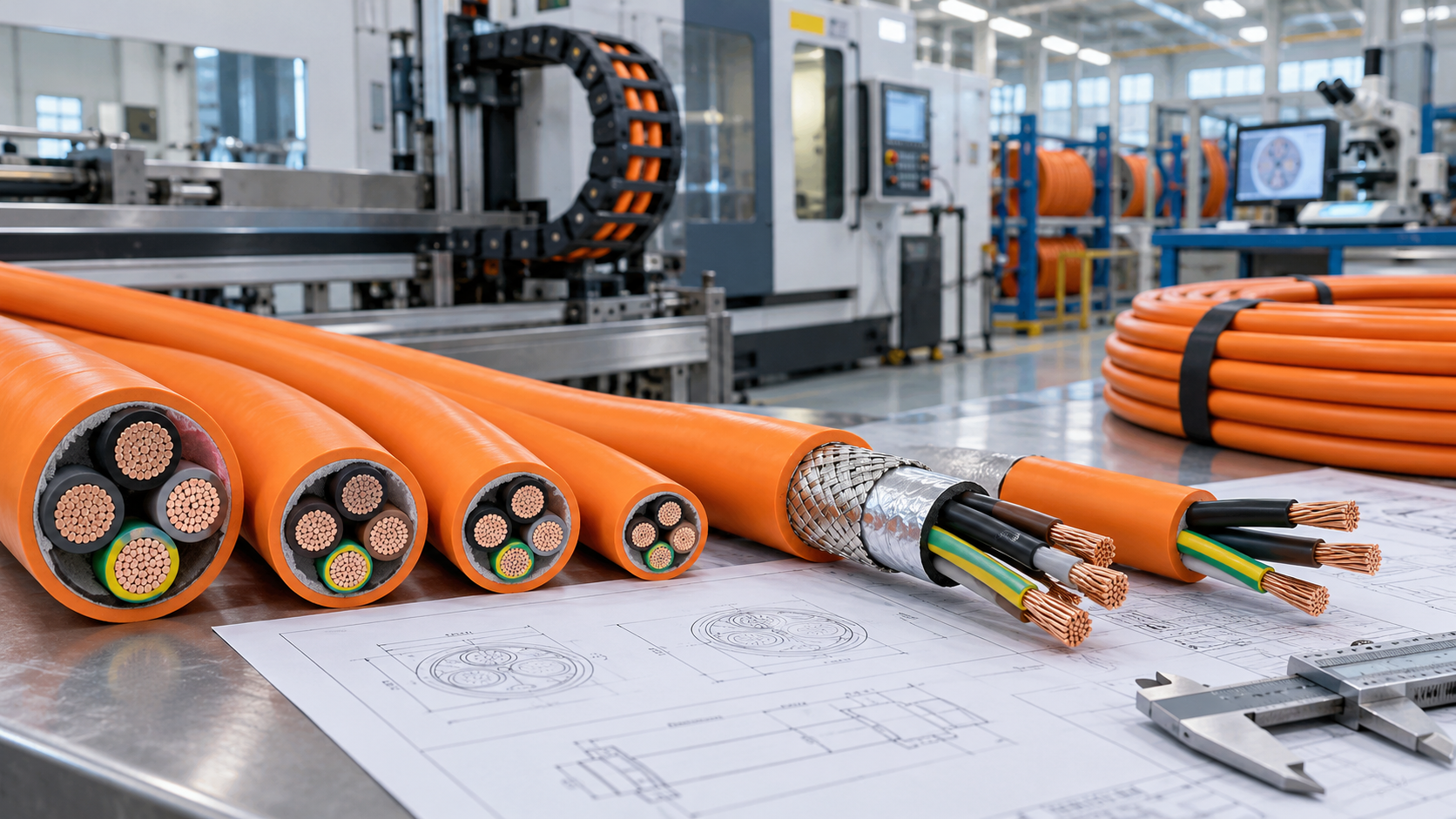
Servo motor power cable price depends on the complete electrical and mechanical specification—not simply the number of meters ordered.
How much is a servo power cable? It is a reasonable question, but there is no reliable standard price that applies to every servo system. A short, unshielded cable for fixed equipment and a shielded continuous-flex cable moving inside a CNC machine's cable carrier may have the same conductor size, yet require very different materials and manufacturing processes.
The final servo motor power cable price depends on copper content, number of cores, shielding, jacket material, flex life, length, quantity and whether connectors are included. Before comparing quotations, buyers should make sure every supplier is pricing the same construction.
This guide explains seven factors that determine servo power cable cost and the information Rolan Cable needs to prepare an accurate factory quotation.
Servo motor cables are normally selected around a specific motor, drive and installation. Motor current determines the conductor cross-section. The drive and machine design determine whether shielding is required. The cable route determines flexibility, bending radius and jacket performance. Connectors, pinouts and cut length depend on the equipment.
For that reason, a price-per-meter comparison can be misleading. A lower quotation may use less copper, a thinner jacket, a different shield, ordinary flexible conductors or a construction that is not designed for repeated movement.
When reviewing prices, compare at least these items:
The best quotation is the one tied to an approved cable drawing and the actual operating conditions.
Copper is usually one of the largest material costs in a servo power cable. Increasing the conductor from 1.5 mm² to 2.5, 4 or 6 mm² adds copper to every meter. A larger conductor also increases insulation, filler and jacket consumption because the finished cable becomes wider and heavier.
Conductor size should be selected according to:
Core configuration matters as well. A common motor power cable may contain three phase conductors and one yellow-green protective earth conductor. Some systems need brake conductors or a different PE arrangement. Those additional cores affect copper weight, cable diameter, bend radius and connector size.
Do not ask for “4-core servo cable” without stating the cross-section of every core. Two four-core cables may contain very different quantities of copper.
Servo drives switch power rapidly and can create electromagnetic interference. A shielded cable helps control emissions when required by the machine's EMC design, especially near encoder, feedback, sensor and communication circuits.
Shielding can include:
Each layer adds material and production steps. Braiding requires additional machinery and time, so the shielded servo cable price is normally higher than the price of an equivalent unshielded construction.
However, shielding is not an optional upgrade chosen only by budget. If the servo manufacturer or EMC design requires a shield, using an unshielded cable to reduce cost can result in interference, alarms or compliance problems. If shielding is not required, paying for a complex dual-shielded structure may add unnecessary diameter and cost.
The shield must also be terminated correctly. A high-quality shield with a long, thin pigtail may perform poorly at high frequencies. Follow the connector, drive and machine grounding instructions.
Jacket material protects the conductors and shield from the working environment. PVC and PUR are common choices, but they suit different conditions.
PVC is a practical option for many indoor automation systems. Depending on the compound, it can provide good flexibility, flame resistance, oil resistance and abrasion protection at an economical cost.
Standard or oil-resistant PVC may be suitable when:
PUR usually costs more than PVC, but it is often selected for more demanding mechanical or environmental conditions. A suitable PUR formulation can provide stronger abrasion, oil and low-temperature performance.
PUR may be justified when:
Material name alone is not enough. Ask for the exact temperature, oil, chemical and abrasion properties of the proposed compound. The most expensive jacket is not automatically the best choice for every machine.
An ordinary flexible cable is easy to bend during installation. A continuous-flex cable is designed to bend repeatedly during machine operation. This distinction has a major effect on construction and price.
A flexible servo power cable for a cable carrier may require:
The supplier also needs the real motion data:
A statement such as “10 million cycles” or “15 million cycles” is meaningful only with its test radius, travel, speed and installation conditions. A high-cycle cable can still fail early if it is twisted during installation or bent below the specified radius.
Rated voltage affects insulation design and testing. A 600/1000V servo power cable may require different insulation dimensions and electrical tests from a lower-voltage control cable.
Environmental requirements also change the price. Tell the manufacturer whether the cable faces:
Broad descriptions such as “oil resistant” are not always sufficient. Where possible, provide the fluid name, concentration, exposure frequency and temperature.
Special compounds and additional tests may increase the quotation, but they can prevent jacket swelling, cracking and unplanned downtime.
Order size influences the price per meter. Production requires conductor stranding, insulation, cabling, shielding, jacket extrusion, printing and testing. Setup costs are spread over fewer meters for a small custom order, so sample and short-run prices are generally higher.
Price can also change with:
Copper prices also move over time, so quotations may have limited validity. When comparing suppliers, make sure the quotations were issued at similar times and include the same freight, packaging, tax and documentation scope.
A custom color or print may seem like a small request, but it can require separate compound preparation and production setup. Ask the supplier to identify the minimum order quantity before confirming the design.
| Specification change | Typical price effect | Main reason |
|---|---|---|
| Larger conductor size | Higher | More copper and larger cable dimensions |
| Additional cores | Higher | More copper, insulation and filling material |
| Foil plus braid shield | Higher | Added metal and manufacturing processes |
| PUR instead of standard PVC | Usually higher | Higher material cost and demanding performance |
| Continuous-flex construction | Usually higher | Fine stranding, controlled structure and testing |
| Small custom quantity | Higher per meter | Setup cost spread across fewer meters |
| Custom color and printing | May increase | Compound, printing and production setup |
This table indicates direction only. An accurate price still requires a complete specification.
Send the following information in your first enquiry:
If the conductor size is unknown, send the original cable drawing, motor datasheet or complete cable marking. The cable manufacturer can review the information, but the machine designer should approve the final specification.
Rolan Cable offers standard and customized servo motor power cable constructions for fixed and moving automation systems. Encoder and feedback signals require a separate cable design; see the servo encoder and feedback cable range when specifying the complete servo connection.
There is no truthful fixed price without a specification. The main factors are conductor size, number of cores, shielding, jacket, flex requirements, length, quantity and connectors. Send the motor and application details for a factory quotation.
Usually yes. Foil, copper braid and related manufacturing processes add material and labor. Shielding may be essential around servo drives, inverters and other electromagnetic-noise sources, so it should not be removed only to lower cost.
PUR generally costs more than standard PVC. Its additional cost may be justified where abrasion, oil, low temperature or mechanical performance is important. A suitable flexible PVC remains a practical choice for many indoor machines.
Yes. Conductor size, core count, shielding, jacket material, color, printing, length and packaging can be customized after the electrical, motion and environmental requirements are reviewed.
No. The cycle rating must match the test conditions and machine motion. Paying for a very high rating does not correct an undersized carrier, tight bend radius or poor installation.
Motor power and encoder feedback have different electrical requirements. Use the cable arrangement specified by the servo manufacturer; sensitive feedback circuits normally require defined twisted pairs and shielding.
The answer to “How much does a servo motor power cable cost?” begins with the motor, electrical load and motion profile. Comparing prices without matching conductor size, shielding, jacket and flex performance can lead to an incorrect or short-lived cable.
Send Rolan Cable your servo motor model, conductor size, core configuration, shielding requirements, cable length, motion data and order quantity. Our team will evaluate the application and provide a suitable cable specification and factory quotation.


